Trailer Wheel & Suspension Torque Guide: Why Proper Torque Matters More Than You Think
One of the most common questions we get at Ramblin' Man is: "What should I torque my wheels or suspension to?"
It's a great question — and one that can make the difference between a safe trip and a roadside disaster. Properly torquing your lug nuts and U-bolts keeps your trailer riding smooth, your wheels secure, and your adventures rolling safely down the highway.
Almost all of our work — from bearing repacks to axle rebuilds — requires customers to re-torque their lug nuts after 50 miles of driving. It's not just a recommendation; it's a critical safety step.
A Real Story: When a Wheel Went Its Own Way
When we first started this journey, we had a customer who called us shaken and confused. He told us his wheel had come clean off his trailer while on the road. Thankfully, no one was hurt and there was no damage to his trailer or anyone else. But when we inspected the wheel hub, we found something surprising — every single lug nut had sheared off cleanly, all at the same point.
At first glance, it looked like an over-torque situation — that's the typical cause of sheared studs.
How We Torque — and Why We Knew It Wasn't Over-Torqued
While we took full responsibility as the last people to service the trailer, we stood by our process:
- We never use impact wrenches for final torque.
- We hand-thread every lug nut before tightening — no cross-threading, no uneven seating.
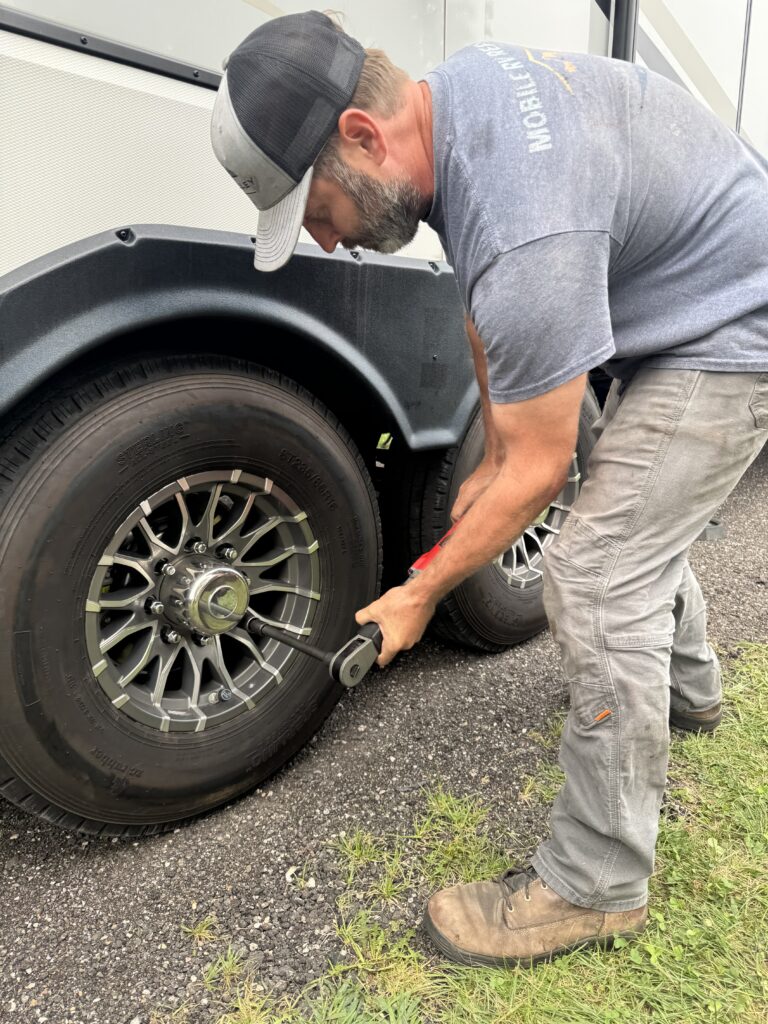
- We torque by hand using a calibrated torque wrench, following manufacturer's recommended specs.
Simply put, it's impossible for us to torque a lug nut by hand strong enough to shear it off. Over-torquing typically comes from high-powered impact guns that can easily exceed 300 ft-lb — far more than most trailer studs are designed to handle.
Investing in Precision: The Milwaukee Electric Torque Wrench
That experience gave Brooke the perfect excuse to add the Milwaukee Digital Torque Wrench to our shop. Not only is it incredibly reliable, but it also records each torque value automatically — we can track, verify, and prove the exact torque used on every job. When we tell someone their lug nuts are torqued to 120 ft-lb, we know exactly how tight they are and have the data to back it up.
⚙️ Lug Nut Torque Specifications
ALWAYS – Recheck your torque after the first 50–100 miles of use, and then every 1,000 miles or at least once a season.
How Do I Know the Size of My Wheel Studs?
Many 1/2″ and 9/16″ wheel studs use a lug nut that can be removed with a 3/4″ and 7/8″ socket respectively. There are 9/16″ lug nuts that use a 3/4″ socket — to know for sure, remove one lug nut and check the size stamped on the side.
Torque Levels for Trailer Wheels
| Typical Wheel Size | Stud Size | Torque (ft-lb) |
|---|---|---|
| 13″–15″ wheels | 1/2″ studs | 90–120 ft-lb |
| 16″ wheels | 9/16″ studs | 120–140 ft-lb |
| 17.5″ and larger | 5/8″ studs | 140–160 ft-lb |
- All specs apply to conical-style lug nuts — standard on most towable trailers.
- Most Alliance RVs are factory-equipped with 1/2″ studs, torqued to 120 ft-lbs.
- Brinkley RVs typically have 9/16″ studs — follow the chart (usually 120–140 ft-lbs).
- 5/8″ studs are usually on 9k axles and may have mag seat lug nuts; torque to 150–175 ft-lbs.
Torque Levels for Trailer U-Bolts
| Bolt Size | Nut Type | Typical Torque (ft-lb) |
|---|---|---|
| 1/2″ | Hex Nut | 60–80 |
| 1/2″ | Flange Nut | 90–110 |
| 9/16″ | Hex Nut | 90–110 |
| 9/16″ | Flange Nut | 100–120 |
Note: Newer Alliance RV models use 1/2″ U-bolts with serrated flange nuts — manufacturer recommends 120 ft-lbs.
🛞 How to Torque Lug Nuts Properly
- Hand-Start the Lug Nuts — Thread each nut by hand to prevent cross-threading.
- Use a Star Pattern — Tighten in a criss-cross pattern so the wheel seats evenly.
- Torque in Two Stages — Step 1: tighten to half of final torque. Step 2: tighten to full torque.
- Re-Torque After 50 Miles — Always recheck torque after reinstalling or rotating wheels.
⚠️ Why Over-Torquing Is Just as Dangerous
You might think tighter means safer — but when it comes to lug nuts, that's not the case. Over-torquing can:
- Stretch or strip wheel studs, making them weaker over time
- Warp rotors or brake drums, leading to vibration or uneven braking
- Crack alloy wheels or cause improper seating
- Lead to stud failure, especially after repeated stress cycles
In our customer's case, after investigating, we concluded the wheel studs had likely been compromised long before the wheel came off — possibly stretched or fatigued from previous over-torque or corrosion. When Brooke removed the wheels, he noted to the customer that the lug nuts were on so tight his torque gun had trouble removing them. Once the trailer hit highway speeds, vibration and stress finished the job.
⚠️ Final Safety Checklist — Before hitting the road:
☑️ Hand-tighten each lug nut first
☑️ Torque in a star pattern
☑️ Use a calibrated torque wrench
☑️ Re-torque after 50 miles
☑️ Never exceed the manufacturer's torque specs
The Bottom Line
Torque isn't just about tightness — it's about balance, precision, and safety. A few extra minutes with a torque wrench can save your wheels, your suspension, and your trip. You don't have to use the same "fancy" Milwaukee torque wrench we do, but you should use a quality, certified torque wrench that is re-certified after each 5,000 uses — we have ours recertified annually.
At Ramblin' Man, we've seen how attention to the little things — like a properly torqued lug nut — can make all the difference. Because sometimes, what keeps your adventure on track isn't horsepower or chrome — it's perfectly torqued lug nuts holding steady mile after mile.
⚠️ Disclaimer
This guide is intended as a general reference for the most common trailer types we service. Torque values and component specifications may vary by manufacturer and model. Always refer to your trailer or axle manufacturer's official documentation for the correct torque specifications and maintenance procedures specific to your unit.